The Changing Face of Texting and Why We Need to Keep Up
Have you ever opened a chat and found yourself staring at a random string of letters? You are definitely not alone in that experience. Modern texting moves at an incredible speed, shifting and changing every single day.
We live in a fast-paced world where nobody has the time to type out long sentences when a quick acronym can do the job. This is exactly why expressions like WFH have taken over our daily digital conversations.
People search for these terms because the line between our professional lives and personal spaces has completely blurred. Missing the true context of a text can lead to awkward silences or entirely misread intentions. Understanding these quick terms helps us stay connected, remove second-guessing, and keep our digital relationships smooth and clear.
WFH – Quick Meaning and Core Definition
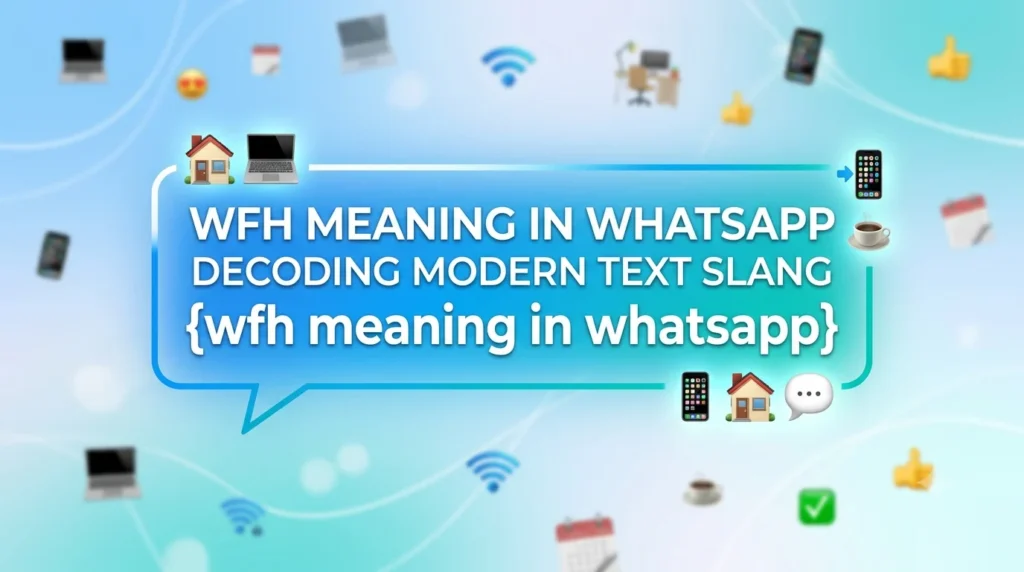
At its absolute core, WFH stands for Work From Home. It is a straightforward lifestyle acronym that transitioned from corporate emails straight into our private chat logs.
When someone drops this term in a message, they are letting you know their physical location and their current state of availability. It serves as a polite boundary marker in modern text communication.
- Primary Meaning: Working from home instead of traveling to a traditional office space.
- Contextual Meaning: I am working, so my responses might be delayed, but I am reachable.
- Visual Status: Sitting at a desk or kitchen table with a laptop, balancing domestic life and professional duties.
“Sorry for the late reply, I am WFH today and the meetings are completely back-to-back.”
“Can we do a quick call? I’m WFH so I don’t have to worry about office noise.”
Origin, Background, and Digital Evolution
The phrase itself belongs to the corporate world, born during the early days of remote network setups and freelance digital culture. For years, it lived quietly inside official company policy handbooks and calendar invites. It was a formal notification used to tell your manager that you would be answering emails from your living room.
Then, global events completely changed how the entire world views labor and communication. Remote arrangements suddenly became the standard baseline for millions of people globally.
As the lifestyle shifted, the language shifted right along with it. The term quickly escaped the strict confines of corporate platforms and flooded into social spaces like WhatsApp and Instagram. It evolved from a stiff corporate status into a universal cultural shorthand for being busy but comfortable.
Real-Life Conversations Across Digital Spaces
WhatsApp Chat
Person A: Hey! Are you free for a quick coffee down at the corner café in ten minutes?
Person B: I wish I could! WFH today and my manager just dropped a massive project on my desk. Let’s definitely do this weekend instead!
Instagram DM
Person A: Your stories look so peaceful today! Are you on a mini vacation or something?
Person B: Haha I love that it looks that way! Just WFH with a nice view from my bedroom window. Still grinding through spreadsheets!
TikTok Comment Section
Person A: That morning routine video is literally so unrealistic who actually has time for all of that?
Person B: Honestly it is only possible because I WFH three days a week. No morning commute saves me two full hours!
Text Message
Person A: Can you pick up the Amazon delivery package when it arrives this afternoon?
Person B: Yeah, absolutely. I’m WFH all day so I’ll be here when the delivery driver rings the doorbell.
Emotional and Psychological Meaning of Digital Shorthand
Using this specific acronym communicates a complex mix of professional focus and personal comfort. It is an easy way to signal that while someone is technically at home, they are not entirely free to lounge around or chat indefinitely. It sets a soft psychological boundary that protects a person’s productivity without making them sound cold or unapproachable to their friends.
In our current digital culture, using short terms reveals a deep mutual desire for maximum efficiency. We want to keep our social circles updated without spending valuable energy typing out elaborate explanations.
A Quick Personal Reflection
Last Tuesday, my cousin messaged me three times while I was deep in the middle of writing a major marketing strategy. Instead of ignoring her or writing a long, stressed-out paragraph about deadlines, I simply texted back a brief update. She instantly understood the situation, gave me my space, and we reconnected later that evening without any hurt feelings.
Usage in Different Contexts and Settings
Social Media Platforms
On public feeds, the term is frequently used to highlight the glamorous sides of remote work setups. You will often see it paired with aesthetic photos of neatly poured lattes, cozy loungewear, and beautifully lit home offices. It serves as a visual badge of flexibility and modern work-life balance.
Friends and Close Relationships
When texting your inner circle, the acronym acts as a practical status report. It tells your friends that you are physically around for casual favors or quick chats, but you still need to respect your professional hours. It keeps your loved ones close while keeping your tasks on track.
Work and Professional Settings
Inside professional channels, the term maintains its original, neat, and organized function. It is a simple way to update your colleagues on your location so they know not to look for you in the physical office building. It sets clear expectations for virtual collaboration.
Casual vs. Serious Tone
The beauty of this term lies entirely in its incredible adaptability. You can easily slide it into a lighthearted joke about staying in your pajamas all day long. On the flip side, you can use it seriously to explain exactly why you cannot attend an important in-person neighborhood gathering.
When NOT to Use It to Avoid Confusion
While the expression is incredibly common, using it in highly formal situations can make you look a bit unprofessional. You should never use casual texting slang when communicating with traditional clients or writing formal company-wide announcements. In those specific scenarios, taking the extra time to type out the full words shows proper respect and attention to detail.
It can also cause minor misunderstandings with older family members who might not be completely familiar with modern internet acronyms. If you tell a relative you are WFH, they might mistakenly assume you are totally free to run errands or have a long chat. In these moments, using plain language keeps everyone on the exact same page.
Common Misunderstandings and Tone Shifts
The most frequent mistake people make is assuming that being at home automatically means a person is free to talk. This assumption can easily create tension when texts go completely unanswered for several hours. The home environment often masks the intense professional pressure a remote worker is actually experiencing.
There is also a subtle figurative usage that catches people off guard. Sometimes, individuals use the term loosely to mean they are completely nesting, recharging their social battery, or intentionally staying inside for the day. Paying close attention to the overall conversation helps you pinpoint the exact meaning intended.
Digital Communication Comparison Table
| Term | Core Meaning | Tone | Best Used For |
| WFH | Working from home | Casual & Professional | Updating location and availability |
| OOF | Out of office | Semi-Formal | Signaling complete unavailability |
| BRB | Be right back | Very Casual | Short, temporary absences from chat |
| OOO | Out of office | Formal | Official email status updates |
| AFK | Away from keyboard | Casual / Gaming | Stepping away from your desk |
Key Insight
Selecting the Right Term Creates Better Connections
Choosing the right acronym completely changes how people perceive your boundaries. Using the correct term ensures your social circle respects your time without feeling ignored.
Variations and Related Expressions
WFO (Work From Office)
Working directly from the company building.
“I will be WFO all next week for the team audits.”
WFA (Work From Anywhere)
Having total geographic freedom to do your tasks.
“Traveling through Europe while enjoying that sweet WFA life.”
WFH Life
A general tag used to describe remote culture.
“My dog is the absolute best part of the WFH life.”
Hybrid Work
Splitting your schedule between home and the office.
“Our company switched over to a hybrid work schedule.”
Digital Nomad
Traveling the world while working entirely online.
“She completely gave up her apartment to become a digital nomad.”
Remote First
A company culture that deeply prioritizes virtual setups.
“They operate as a remote first organization now.”
Desk Setup
Sharing photos of your physical workspace.
“Upgrading my desk setup with a new chair.”
Zoom Fatigue
Feeling completely exhausted from endless video calls.
“That last afternoon meeting gave me serious Zoom fatigue.”
Deep Work
Focusing entirely on difficult tasks without any distractions.
“Going offline for two hours to get some deep work done.”
How to Respond When Someone Uses It
Casual Replies
- “Nice! Enjoy the cozy vibes today.”
- “Jealous! Hope your day flies by quickly.”
- “Awesome, let’s catch up properly after you wrap up.”
Funny Replies
- “Admit it, you are definitely still wearing your pajama pants!”
- “Please tell your furry coworker hello for me.”
- “Don’t work too hard while staying so close to the fridge!”
Mature Replies
- “Understood, I will let you focus and we can talk later.”
- “No worries at all, ping me whenever you get a free moment.”
- “Good luck with your tasks today, talk soon.”
Respectful Replies
- “Thank you for letting me know your status, have a productive day.”
- “I appreciate the heads-up, I will keep our messages brief.”
- “Have a wonderful and focused workday.”
Regional, Cultural, and Generational Usage
Western Culture
In regions like the United States and Western Europe, this term is deeply embedded in the standard corporate vocabulary. It represents a highly valued cultural emphasis on personal autonomy, work-life balance, and individual flexibility.
Asian Culture
Across many Asian professional environments, the adoption of remote terms has historically been a bit slower due to a deep cultural appreciation for in-person collaboration. However, the tech sectors in these regions now use the term constantly in daily chat groups.
Middle Eastern Culture
In the Middle East, the expression is rapidly gaining popularity among young digital professionals in booming urban centers. It signals a strong alignment with global business practices and modern workplace shifts.
Global Internet Usage
On the open web, the term functions as a universal language that completely transcends geographic borders. It connects remote workers worldwide, allowing them to share jokes, tips, and experiences across different time zones.
Generational Differences (Gen Z vs. Millennials)
Millennials generally view the lifestyle as a hard-earned professional benefit that helps them balance growing family needs. Gen Z text users view it as an absolute baseline expectation for the modern world, often mixing the term into creative memes and rapid-fire social videos. For more insights on how naming conventions and terms evolve across different generations, check out resources on NameMeaningZone.
Is It Safe for Kids?
This acronym is completely safe for children and teenagers to use. It carries absolutely no inappropriate, hidden, or harmful double meanings. It is a strictly functional piece of modern lifestyle vocabulary.
When kids see this term online, it is usually in the context of their parents’ work schedules or older siblings talking about university setups. Understanding it simply helps younger users learn how the modern adult world communicates. For a deeper understanding of language trends, you can explore the Cambridge Dictionary to see how modern terms are officially cataloged.
Frequently Asked Questions
What does WFH stand for in WhatsApp chats?
It stands directly for Work From Home. People use it to tell their contacts that they are managing their professional duties from their personal residence.
Is WFH considered professional language?
Yes, it is widely accepted in casual professional channels like Slack or Microsoft Teams. However, it should still be avoided in highly formal contracts or official executive emails.
Can WFH mean something else entirely?
In the vast majority of conversations, it exclusively means working from home. There are no common alternative slang definitions for this specific acronym.
Why do people use WFH instead of typing the full words?
It saves valuable time during fast text conversations. It lets the recipient know your availability status in a split second.
How do I use WFH correctly in a sentence?
You can simply say, “I am WFH today, so feel free to call my mobile number if you need anything urgent.”
Final Thoughts on Modern Texting Clarity
Embracing modern shorthand is not about throwing proper grammar out the window. It is about learning how to connect with the people around us in the most effective way possible.
The next time you see this term pop up in a WhatsApp notification, you will know exactly how to read the room. Use these expressions with total confidence, respect people’s digital boundaries, and keep your conversations flowing naturally.
![It looks like your prompt contains a template meant for a slang term or phrase, but the bracketed slot says [ esports team name ] while the structure asks for an analysis of a term/slang expression (including slang variations, regional usage, and “Is It Safe for Kids?”).](https://namemeaningzone.com/wp-content/uploads/2026/08/esports-team-name-150x150.webp)