Digital communication moves at lightning speed, leaving many of us scratching our heads over everyday abbreviations. If you have ever stared at your phone screen wondering what a specific shorthand means, you are certainly not alone.
Texting culture thrives on efficiency, blending technological terms with casual street lingo. Understanding these subtle shifts in language ensures you never miss the true intent behind a message.
Decoding the Digital Screen: Why We Search for Slang Meanings
We live in an era where a single lowercase abbreviation can change the entire dynamic of a conversation. People frequently search for these terms because digital language evolves much faster than traditional dictionaries can keep up.
Misinterpreting a text can lead to unnecessary social anxiety, missed connections, or awkward professional blunders. Resolving these small linguistic mysteries helps us communicate with absolute confidence.
iMsg – Quick Meaning
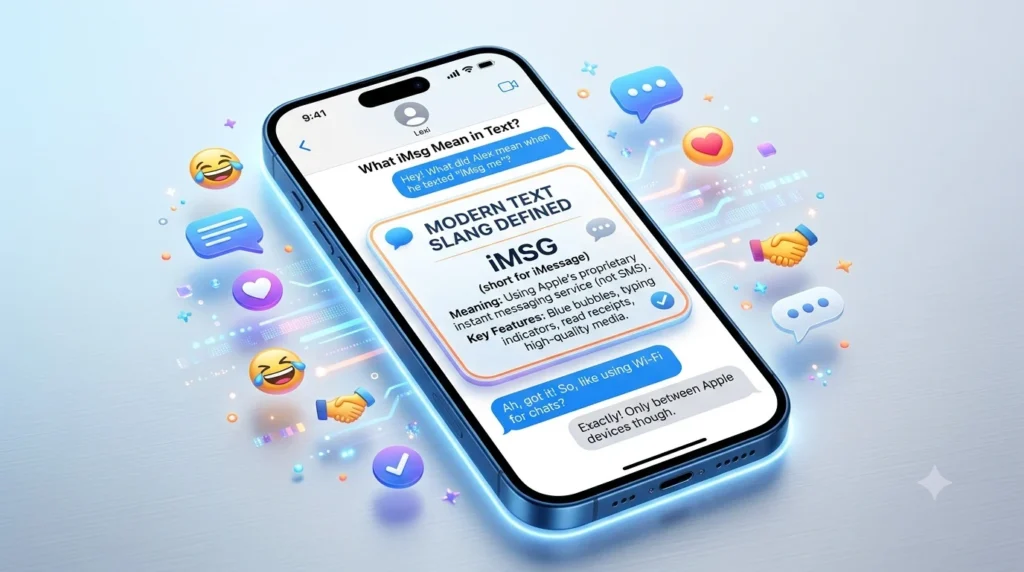
At its core, iMsg is a universal shorthand for iMessage, Apple’s proprietary instant messaging service built directly into iOS, iPadOS, and macOS devices.
When someone uses this term in a text, they are either referring to the platform itself or indicating that they want to switch from standard SMS to Apple’s blue-bubble chat network.
- Primary Definition: Short for iMessage (Apple’s native messaging ecosystem).
- Alternative Definition: A quick way to say “send me an internet-based text message.”
- Visual Indicator: The famous “blue bubble” on an iPhone screen.
“Drop me an iMsg when you get home so I know you’re safe.”
“My cellular data is running incredibly slow, so my iMsg won’t go through.”
“Are we chatting on normal SMS or is your iMsg working now?”
Origin & Background
The term traces its lineage directly back to 2011, when Apple officially launched its dedicated messaging infrastructure to bypass traditional cellular texting fees.
The Apple Ecosystem Influence
Before this digital shift, every text message cost a small fee or deducted from a monthly carrier allowance. Apple revolutionized this by routing texts through Wi-Fi or cellular data, introducing the iconic distinction between green and blue text bubbles.
Social Media Impact and Evolution
Over the years, internet culture adopted the abbreviation to differentiate high-quality chat threads from basic network texting. It evolved from a mere technical feature into a cultural status symbol, heavily influencing how younger generations interact online.
Real-Life Conversations
To see how this abbreviation functions in daily life, let us look at a few realistic communication scenarios across various popular platforms.
WhatsApp Group Chat
Person A: Hey, my cellular network reception is absolutely terrible inside this building.
Person B: Just switch over to Wi-Fi and send me an iMsg, it goes through much faster.
Instagram DMs
Person A: I am about to board my flight, heading out of the country now!
Person B: Perfect, use the free inflight Wi-Fi to iMsg me when you land.
TikTok Comment Section
Person A: Why does the video quality look so pixelated when you send videos to Android users?
Person B: Because you aren’t using iMsg to share the files!
Standard Text Messages
Person A: Are you receiving my standard cellular texts today?
Person B: Yes, but let’s chat on iMsg instead so we can see the typing indicators.
Emotional & Psychological Meaning
Linguistics is never just about the literal words; it carries massive emotional weight in our interpersonal relationships.
The Subtle Psychology of the Blue Bubble
Using this specific platform creates an instant sense of digital intimacy and inclusion. It signals to the other person that you share a compatible piece of technology, which unconsciously fosters a smoother, more immediate conversational flow.
A Personal Scenario from the Field
During a digital marketing campaign launch last year, a client was growing anxious over delayed text updates. I realized our standard SMS thread was dropping images. The moment we shifted to an active iMsg thread, the real-time typing bubbles and read receipts instantly lowered the client’s stress levels, restoring complete trust in our workflow.
Usage in Different Contexts
The appropriateness of this abbreviation relies entirely on who you are talking to and the platform you are currently using.
Social Media & Digital Spaces
On public forums, the term serves as a quick label for high-speed, media-rich texting. It highlights the difference between basic carrier texts and modern internet-based communication.
Friends & Romantic Relationships
Among close friends, saying “iMsg me” implies a desire for a long, continuous conversation filled with emojis, voice notes, and live reactions. It represents a casual, open-door policy for chatting.
Work & Professional Settings
In a corporate environment, you must exercise caution. While it is perfectly fine to use with close colleagues, you should stick to formal terms like “text message” or “mobile ping” when speaking directly with upper management.
When NOT to Use It
Misapplying digital terminology can occasionally create unnecessary friction or alienate the person on the receiving end of your text.
The Cross-Platform Divide
Never demand an “iMsg” from someone who proudly uses an Android device. Because the platform is strictly exclusive to Apple hardware, using the term contextually with an Android user can feel mildly exclusive or confusing.
High-Stakes Professional Environments
When sending formal updates to a brand new business client, avoid short slang. Stick to universally understood phrases to ensure your communication remains thoroughly polished.
Common Misunderstandings
Clear communication requires us to deconstruct the myths surrounding modern digital terminology.
The Software vs. Hardware Confusion
A common mistake is thinking the abbreviation refers to a completely separate app downloadable on any phone. In reality, it is deeply embedded directly into the native messaging app of specific devices.
Literal Texting vs. Data Messaging
Many users confuse standard network SMS with data-driven messaging. Understanding that one relies on phone lines while the other relies entirely on internet data changes how we troubleshoot communication issues.
Comparison Table
To help visualize how this term stacks up against other common digital messaging shorthand, let us look at this quick reference guide.
| Abbreviation | Core Platform | Tone Profile | Primary Medium |
| iMsg | Apple iMessage | Casual / Tech-Friendly | Data / Wi-Fi |
| SMS | Universal Carrier | Traditional / Formal | Cellular Network |
| DM | Instagram / Twitter | Social / Casual | App Platforms |
| PM | Facebook / Forums | Direct / Private | Website Systems |
Key Insight
While terms like DM and PM belong strictly to social media ecosystems, iMsg bridges the gap between official mobile carrier texting and web-based instant messaging networks.
Variations & Types
Digital shorthand often shifts slightly depending on how quickly a person is typing on their touchscreen keyboard.
imsg
The most common, lowercase variation used in rapid, casual text exchanges with close peers.
iMessage
The official, fully spelled-out brand name used in technical discussions and formal business copy.
iM
A deeply truncated version used by younger generations to save screen space during fast typing.
Apple Text
A descriptive variation often utilized by individuals who prefer literal descriptions over brand slang.
Blue Bubble Chat
A highly stylized, cultural slang term focusing entirely on the visual appearance of the message.
iOS Ping
A tech-centric variation used predominantly within development circles or digital marketing agencies.
Cloud Text
A descriptive term highlighting that the conversation is being saved and synced across cloud servers.
Net Text
An older, transitional piece of slang used when internet-based texting first began replacing standard carrier networks.
How to Respond When Someone Uses It
Your reply should always match the energy, context, and intent of the person who initiated the conversation.
Casual Replies
“Sounds good, switching over to my laptop now so I can type faster!”
Funny Replies
“Green bubbles only over here today, my data plan is fighting for its life!”
Mature Replies
“I will send over the updated project files via that channel as soon as I reach the office.”
Respectful Replies
“Thank you for the update, I will make sure my device is connected to Wi-Fi to receive the documents.”
Regional & Cultural Usage
The way people view internet messaging platforms varies wildly based on geography and generational shifts.
Western Culture Dynamics
In North America, the divide between messaging formats is a significant cultural talking point. The blue text bubble is heavily associated with social inclusion, especially among high school and university students.
Global Internet & Asian Markets
In many regions across Asia and Europe, native device texting is largely ignored in favor of third-party applications like WhatsApp, WeChat, or Line. In these regions, the term is rarely used in daily conversation.
Generational Shifts: Gen Z vs. Millennials
Millennials remember the transition from pay-per-text limits to free internet messaging, so they view the platform as a convenient tool. Gen Z, however, views it as a baseline standard for digital identity and daily socializing.
Is It Safe for Kids?
The term itself is completely safe, as it is merely a technical abbreviation for a built-in phone feature. However, parents should still monitor the safety of online environments by utilizing parental control systems. For a comprehensive look at understanding digital identities, names, and online safety profiles, resources like the Name Meaning Zone can offer excellent guidance for families managing the modern web.
FAQs
What is the difference between an iMsg and a regular text?
An iMsg uses an internet connection to send texts, high-res media, and effects with a blue bubble, whereas a regular text uses cellular networks via SMS with a green bubble.
Can you send an iMsg to an Android phone?
No, the service is exclusive to Apple devices. Messages sent to Android devices automatically convert to standard SMS text messages.
Why do my messages turn green instead of blue?
This occurs when your device loses internet connectivity, when the Apple servers are temporarily down, or when you are texting a non-Apple device.
Does using this messaging service consume phone data?
Yes, it relies entirely on an active internet connection. If you are not connected to Wi-Fi, it will use a small amount of your mobile cellular data.
Is the platform secure for sending private info?
Yes, the network uses end-to-end encryption, meaning the content of your texts is safe from external interception during transit.
Final Thoughts
Language is a living, breathing entity that adapts to the tools we use every single day. Embracing abbreviations like iMsg allows us to navigate our daily digital landscapes with ease, clarity, and genuine confidence.
The next time you see this term pop up on your screen, you can smile knowing exactly what it means. For more insightful breakdowns of modern language trends, technical acronyms, and digital communication terms, feel free to check out the authoritative guides over at the Oxford English Dictionary. Stay curious, keep communicating clearly, and enjoy the seamless flow of modern conversation!
![It looks like your prompt contains a template meant for a slang term or phrase, but the bracketed slot says [ esports team name ] while the structure asks for an analysis of a term/slang expression (including slang variations, regional usage, and “Is It Safe for Kids?”).](https://namemeaningzone.com/wp-content/uploads/2026/08/esports-team-name-150x150.webp)