Walking into a tech arena at Friday night kickoff is an experience unlike any other. The room hums with energy, cables snake across floors, and caffeine supplies are stacked high.
Yet, before the first line of code is written, teams face a psychological hurdle that sets the tone for the entire weekend. They must choose a title that defines their identity.
Your team moniker is more than a line on a leaderboard. It acts as your brand, your rallying cry, and your first impression on judges who review dozens of projects.
The True Value Behind Hackathon Team Names
Choosing the right title is an unwritten rule of competitive tech culture. Teams often struggle to balance technical cleverness with approachability, leading to hours of debate before development even begins.
People search for the perfect identity because it fills a critical gap between professional competence and creative expression. A generic name feels uninspired, while an overly complex one misses the mark with judges.
Finding that sweet spot solves the collective anxiety of looking unprepared. It gives a group of individual developers, designers, and project leads a unified sense of purpose before the pressure mounts.
Hackathon Team Names – Quick Meaning
At its core, this identity is a collaborative label used by groups participating in timed sprint competitions to summarize their collective skill, attitude, or thematic focus.
- It acts as a strategic branding tool for a short-term, high-intensity project.
- It builds instant camaraderie among team members under tight deadlines.
- It serves as a memorable hook for judges and sponsors during final pitches.
“We changed our name from Group 4 to The Runtime Terror at 2:00 AM, and suddenly our energy shifted. We weren’t just tired students anymore; we were a crew on a mission.” – Sarah, UX Designer
“A great name doesn’t just sound cool. It tells the judges exactly how much personality and confidence you bring to the table before they even see your slide deck.” – David, Senior Software Engineer
Origin & Background
The tradition of naming collaborative tech groups traces back to early university computer clubs and localized LAN parties of the late twentieth century. Early programmers used inside jokes and hardware terminology to build a sense of community.
The Evolution of Tech Culture
As informal hacking sessions transformed into structured, corporate-sponsored hackathons, the way teams branded themselves evolved. Monikers shifted from dense, inaccessible jargon to witty, pop-culture-infused titles that anyone could appreciate.
Cultural and Social Media Influence
Today, viral memes and platforms like TikTok and GitHub heavily influence team branding. A group that embraces current internet humor or trending tech discussions stands out immediately in a sea of traditional corporate submissions.
Real-Life Conversations
To understand how these titles shape peer dynamics, look at how modern participants discuss them across different digital communication channels.
WhatsApp Group Chat
Developer A: Hey everyone, I just set up our official registration link. We need to submit our team name by midnight. Any ideas?
Developer B: Something classic? Like Byte Me or Code Crusaders?
Developer A: Byte Me feels a bit overused. Let’s go with Ctrl+Alt+Defeat. It shows we are here to win but don’t take ourselves too seriously!
Instagram DMs
Designer: I am working on our presentation slide template. What are we officially calling ourselves for the pitch?
Product Manager: We decided on The Algorithm Alchemists during dinner.
Designer: Love it! That gives me so much room to create a sleek, magical tech aesthetic for the visuals.
TikTok Comments
User 1: Our team at the fintech hackathon literally named themselves No Sleep Till Deployment 😭
User 2: Honestly relatable, we went with Coffee & Concurrency and lived up to it completely.
Discord Server
Moderator: All teams must update their nicknames in the server to match their official project registration.
Team Lead: Team Bug Hunters changing names to Feature Creep now. Wish us luck!
Emotional & Psychological Meaning
An identity chosen under a tight deadline reveals a great deal about a group’s collective mindset. It expresses confidence, shared vulnerability regarding the lack of sleep, or pride in technical mastery.
Psychologically, adopting a quirky or powerful title breaks down social barriers between new teammates. It creates a psychological safety net, allowing individuals to take bigger creative risks during production.
During a regional environmental tech event, my team spent two hours arguing over project scope until we named ourselves The Green Screen Crew. That simple, lighthearted choice aligned our focus and reminded us to keep our solution visually impactful and eco-centric.
Usage in Different Contexts
The appropriateness of a title depends heavily on the specific venue, the stakeholders involved, and the overall goals of the event.
Social Media and Online Sprints
Virtual, global events allow for highly experimental, meme-centric titles. Since interactions happen via chat screens, using bold, trendy internet slang helps a group stay memorable to remote mentors.
Friends and Campus Events
University hackathons are the perfect place for inside jokes, professor puns, and self-deprecating humor about student life. The atmosphere is collaborative, making playful titles highly effective.
Corporate and Professional Settings
When competing in events hosted by major enterprise firms, balancing wit with professionalism is essential. Focus on forward-looking, impactful phrases that emphasize problem-solving and scalability.
When NOT to Use It
While humor and edge can set a group apart, certain boundaries should never be crossed if you want to maintain professional credibility.
Avoid names that rely on offensive language, exclusionary cultural jokes, or overly aggressive stances toward other competitors. A title that alienates judges or organizers will ruin your chances of winning, regardless of how brilliant your code is.
If a title requires an extensive, uncomfortable explanation to prove it isn’t inappropriate, discard it immediately. Keep your choices clever, inclusive, and clean.
Common Misunderstandings
The biggest mistake teams make is picking a name that is completely disconnected from their actual project or personality.
| Category | Creative/Witty Names | Corporate/Serious Names |
| Primary Goal | Entertain, build camaraderie, and stay memorable. | Demonstrate authority, scalability, and business value. |
| Best Venues | Student hackathons, open-source sprints, casual jams. | Venture capital pitches, enterprise events, internal corporate sprints. |
| Potential Risk | Might not be taken seriously by traditional judges. | Can sound dry, forgettable, or overly corporate. |
Key Insight
The most successful groups find harmony by pairing a witty team title with a highly professional, clear project name during their final presentation.
Creative Variations & Inspiration
When looking for the perfect fit, exploring different categories can help spark the right concept for your specific crew. Discover more unique branding ideas for your next venture at NameMeaningZone, where naming architecture meets cultural insight.
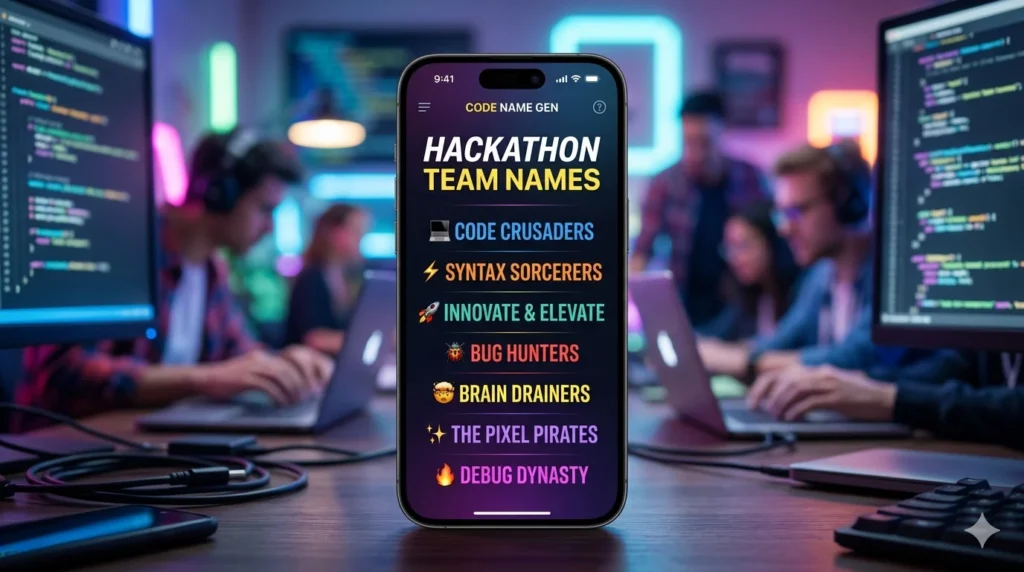
- The Syntax Sorcerers: Ideal for teams that specialize in solving incredibly messy, legacy code issues.
- Out of Memory: A humorous nod to the exhaustion and heavy processing demands of a 48-hour sprint.
- Data Diggers: Perfect for analytics-focused groups turning massive datasets into clean visual narratives.
- The Bug Stops Here: An authoritative, confidence-driven option for expert quality assurance and debugging crews.
- Stack Overlords: A playful tribute to the community platforms that keep every modern developer alive.
- API Accomplices: Excellent for teams focused on building seamless integrations and third-party connections.
- Null Pointers: A classic, self-deprecating option for groups who love pure computer science humor.
- Brute Force: Best suited for high-energy teams that push through challenges with sheer determination.
- Callback Cats: A stylish, modern option for JavaScript developers and front-end specialists.
- Agile Avengers: Tailored for groups that pride themselves on rapid prototyping and flawless project management.
How to Respond When Someone Inquires About Your Name
When mentors or judges ask about your choice during floor rounds, your response should reinforce your team’s collective personality.
Casual and Friendly Responses
“We chose it because it was either this or Sleep Deprived, and we wanted to preserve a little bit of our dignity!”
Funny and Quick Responses
“It represents our current state of mind: mostly functional, but highly dependent on external inputs.”
Mature and Project-Focused Responses
“We wanted something that highlighted our focus on efficiency, and this title perfectly matches our approach to lean architecture.”
Regional & Cultural Usage
Tech culture feels universal, but regional differences subtly influence how teams approach self-branding during competitive events.
In Western tech hubs, teams lean heavily into irony, current pop culture references, and self-deprecating humor. Conversely, in many Asian tech ecosystems, names often highlight unity, rapid progress, and high structural ambition.
Generational gaps play a major role as well. Gen Z teams frequently utilize absurdist humor and platform-specific memes, while Millennials often favor structured puns and classic gaming references.
Is It Safe for Younger Competitors?
The practice of naming hackathon groups is entirely safe and highly recommended for youth divisions, robotics leagues, and STEM camps.
It encourages kids to view technology as a collaborative, creative playground rather than a solitary academic chore. For younger age groups, guiding them toward fun, animal-themed, or superhero-inspired tech titles keeps engagement high and builds early team spirit.
Frequently Asked Questions
Does our team name actually affect our final score?
Officially, judges grade based on criteria like innovation, design, and technical execution. However, a memorable title creates a strong psychological anchor that helps judges remember your presentation during final deliberations.
Should our team title match our specific project name?
Not necessarily. Your group moniker represents your collective identity for the entire weekend, while your project name should focus specifically on the solution you built.
What should we do if another group takes our idea?
Keep a backup option ready before opening ceremonies. If someone beats you to registration, simply pivot to a funny variation or add a creative modifier to your title.
Can we change our name halfway through the competition?
Most hackathons allow modifications up until final project submission. If your project takes a completely different direction on Saturday night, feel free to update your title to match your new path.
How long should a good team name be?
Keep it between two and four words. Anything longer becomes difficult to read quickly on leaderboards and tricky for hosts to announce on stage.
Final Thoughts
At the end of the weekend, the project you build is only part of the experience. The late-night breakthrough sessions, the shared frustrations, and the inside jokes stay with you long after the servers close.
Picking an identity is your first chance to own your space in the tech community. Choose a name that makes your crew smile, wear it with pride during your pitch, and let that shared energy carry you all the way to the final demo.
![It looks like your prompt contains a template meant for a slang term or phrase, but the bracketed slot says [ esports team name ] while the structure asks for an analysis of a term/slang expression (including slang variations, regional usage, and “Is It Safe for Kids?”).](https://namemeaningzone.com/wp-content/uploads/2026/08/esports-team-name-150x150.webp)